THE LION FAMILY
Lessons About Love, Care, Family, Leadership, Conflict, and Human Relationships

Chapter 1
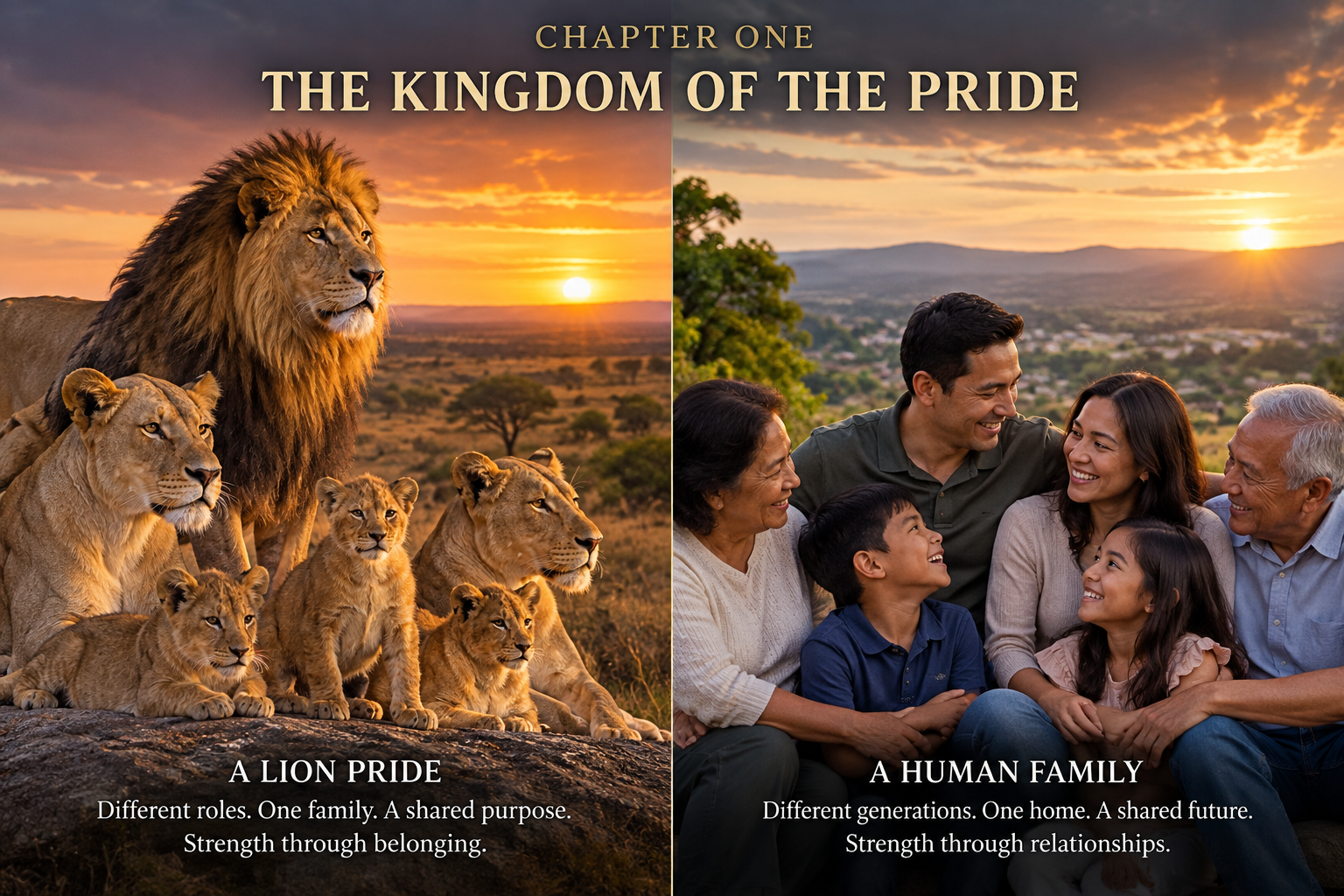
CHAPTER ONE
THE KINGDOM OF THE PRIDE
Across the great African wilderness, where the grass moves with the wind and the sun rises over endless plains, there lives an animal that has captured the imagination of humanity for generations—the lion.
The lion is commonly associated with strength, courage, leadership, and power.
But behind the powerful image of the lion lies something more important: relationship.
A lion does not simply exist as an individual. Lions can live within social groups known as prides, where individuals interact, cooperate, compete, protect young, establish territories, and respond to changes within the group.
The pride is a world of relationships.
There are mothers and cubs. There are young lions learning the environment. There are adults competing for position and resources. There are moments of cooperation and moments of conflict.
This makes the pride an interesting mirror for humanity.
Human beings also live in groups.
We have families, friendships, communities, organizations, and nations.
We depend upon one another.
A child depends upon parents.
Parents depend upon one another.
Businesses depend upon employees.
Employees depend upon customers.
Communities depend upon cooperation.
Nations depend upon citizens.
No matter how independent a person believes they are, their life is connected to the lives of others.
The first lesson of the lion is therefore not about power.
It is about belonging.
A human being needs to know where they belong, who cares about them, who will protect them, who will correct them, and who will stand beside them during difficult moments.
The pride therefore becomes a metaphor for the human family.
The question is not simply:
"How strong am I?"
It is:
"How strong are the relationships around me?"
chapter 2
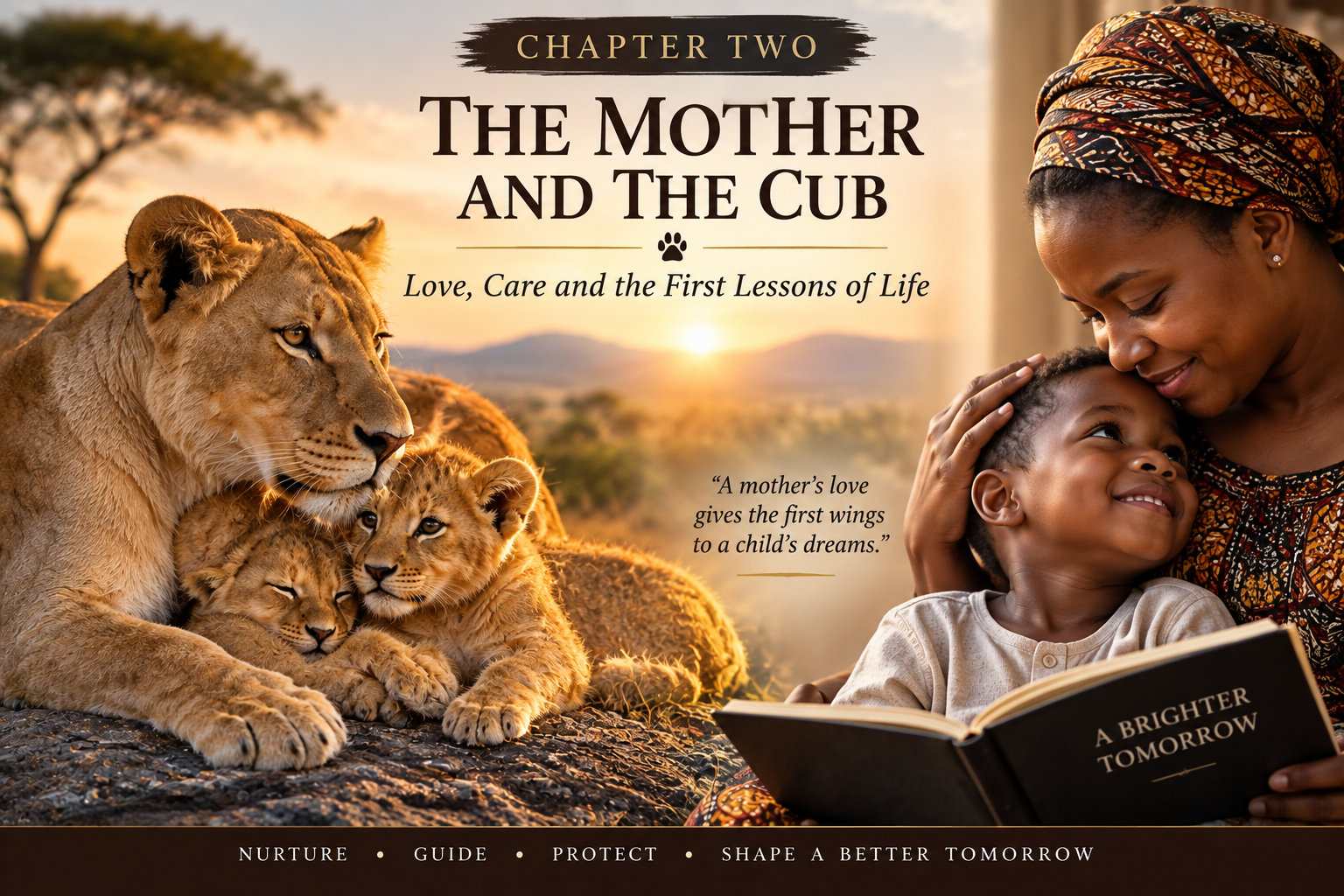
THE MOTHER AND THE CUB
The story of the lion family begins with the young.
A cub enters the world without the ability to survive independently. It needs protection, nourishment, and guidance.
The cub does not understand danger.
It does not understand the territory.
It does not know how to hunt.
It must learn.
This is one of the greatest similarities between lions and human beings.
A human child is born with enormous potential but very little knowledge of the world.
The child does not know how to speak properly.
The child does not understand money.
The child does not understand relationships.
The child does not understand responsibility.
The child does not know how society works.
Everything must be learned.
And much of that learning begins inside the family.
A mother therefore becomes more than someone who feeds a child.
She becomes part of the environment in which the child develops.
Through her behavior, the child learns.
Through her patience, the child learns.
Through her discipline, the child learns.
Through her affection, the child learns.
Through her reactions to difficult situations, the child learns how to respond to difficulty.
The child watches.
Sometimes the child watches more than the parent realizes.
This creates a powerful responsibility for parents:
Children do not only inherit possessions. They inherit patterns of behavior.
If a child grows up watching adults solve problems through communication, the child may learn communication.
If the child grows up watching adults solve every disagreement through anger, anger can become normal.
If the child sees honesty, honesty becomes familiar.
If the child sees generosity, generosity becomes familiar.
The family is therefore the first school of humanity.
chapter 3
THE FATHER AND THE MEANING OF PROTECTION
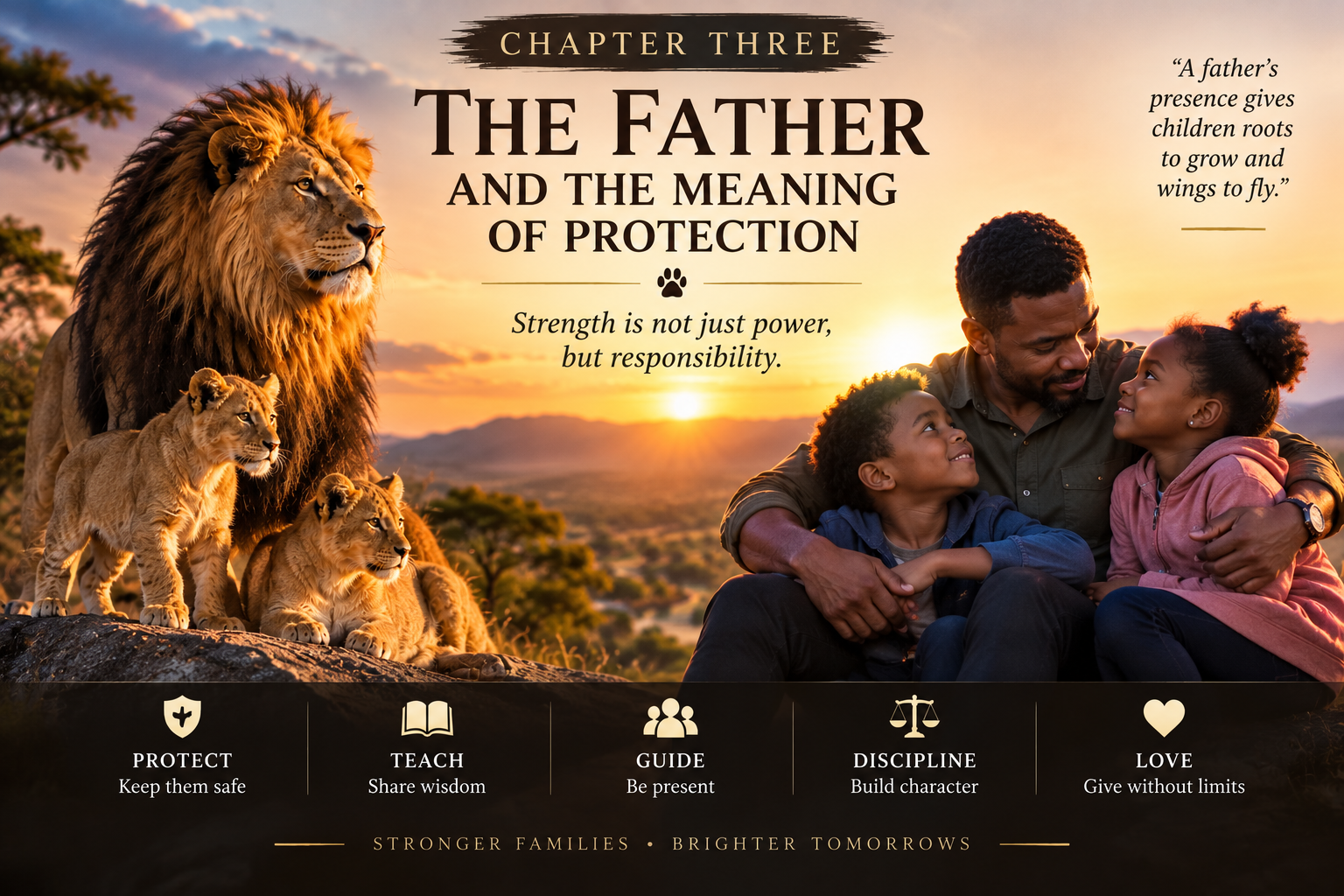
The male lion is often portrayed as the symbol of protection and authority.
For humans, however, fatherhood must mean more than physical strength.
A father can protect his family financially, physically, emotionally and morally.
But protection is not the same as control.
A father who says:
"I am the head of this family"
must also be willing to say:
"I am responsible for this family."
Authority without responsibility can become oppression.
Responsibility without involvement can become absence.
A father should therefore ask himself:
What am I teaching my children?
What example am I giving them?
Do they see honesty in me?
Do they see discipline?
Do they see respect?
Do they see compassion?
Do they know that I am available when they need guidance?
Children do not need a perfect father.
They need a responsible one.
A father who makes mistakes but admits them teaches something powerful.
He teaches that being strong does not mean pretending to be perfect.
Sometimes the strongest sentence a father can say is:
"I was wrong. Forgive me."
That sentence can teach a child more about leadership than a hundred speeches.